Palmistry
Your palm is a unique map, traced by your genetics, sculpted by your experiences, revealing of your deeper personality. Palmistry does not predict the future to the letter: it offers you a mirror. By learning to read the lines of your hand, you begin to understand your natural tendencies, your strengths and the patterns that run through your life.
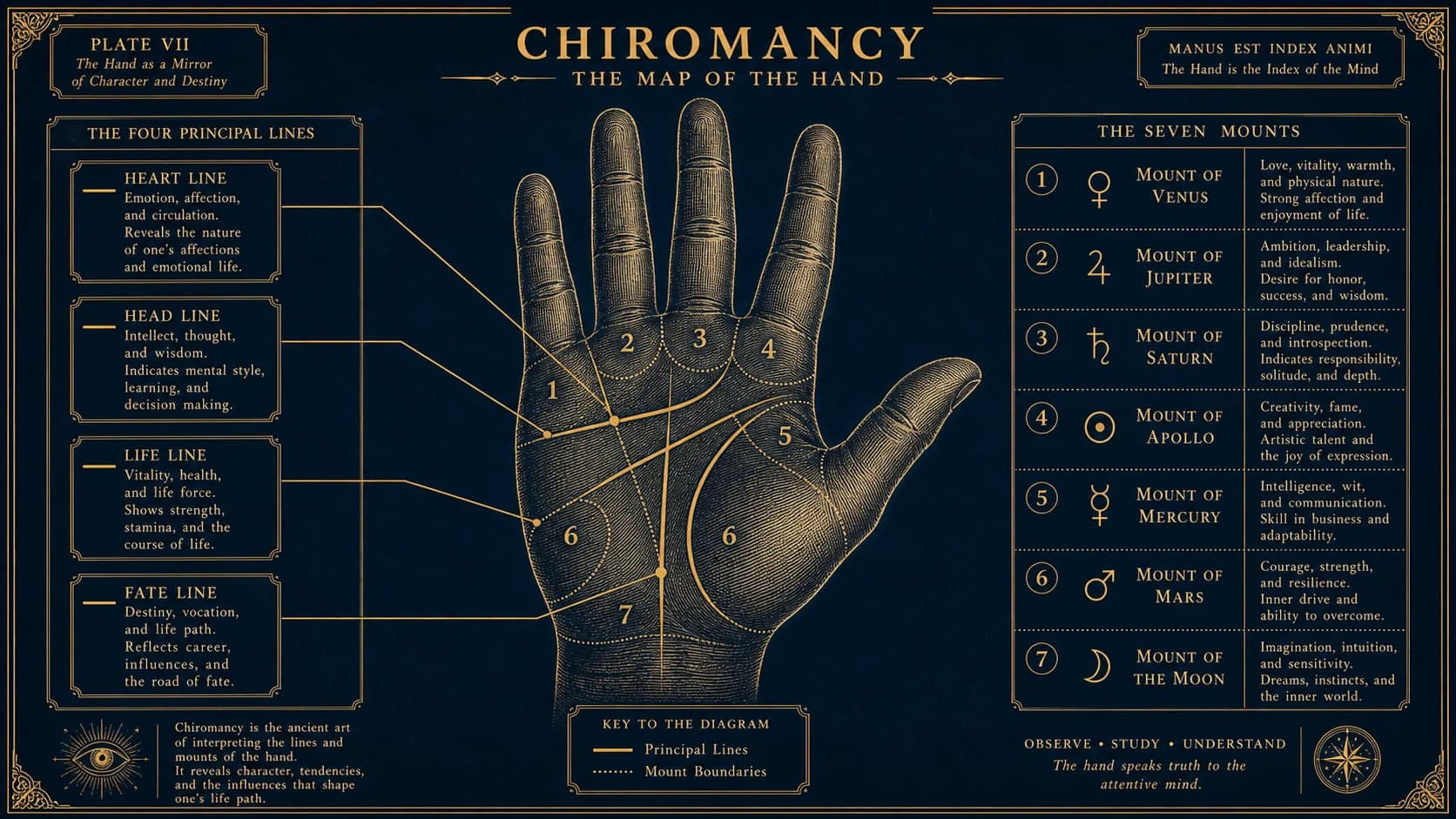
The life line curves around the mount of Venus and indicates vitality, major life turning points and overall energy. Its length does not predict lifespan, contrary to popular belief. The heart line, starting beneath the little finger, reflects your emotional life, how you love, and your relational expectations. The head line crosses the center of the palm and says a great deal about your thinking style: straight for logical thought, curved for fertile imagination. Finally, the fate line (not present in everyone) rises vertically toward the middle finger and speaks of career, vocation and the sense of moving in the right direction.
The seven mounts of the hand amplify or temper what the lines reveal. The Venus mount (at the base of the thumb) signals human warmth and sensuality when it is full and firm. The Jupiter mount (below the index finger) points to ambition and leadership. The Saturn mount (below the middle finger) speaks of seriousness and discipline. The overall shape of the hand completes the picture: a square palm with short fingers signals a practical, earthy nature, while a long palm with slender fingers betrays artistic sensitivity and developed intuition.
Which hand to read: right or left?
In Western palmistry, the dominant hand is read first: it reflects who you have become, the path you have taken. The non-dominant hand shows your birth potential, your natural predispositions. Ideally, compare the two: the differences between them are often the most revealing.
Do the lines change over time?
Yes. The skin of the palm evolves slowly, and certain lines deepen, branch or appear over the years. This is precisely why palmistry is seen as a reflection of your lived life, not a destiny set in stone.
Is palmistry a reliable science?
Palmistry is a symbolic practice, not a science in the academic sense. It is valuable as a tool for introspection: it invites you to ask questions about yourself. Users who approach it with openness often report surprising resonances with their real experience.
Take the next step
Your hand holds your story
Read My Palm