Tarot
Tarot is not an oracle that predicts the future: it is a mirror that reflects what is already happening within you. Its 78 cards form a universal vocabulary drawn from the collective unconscious: each image speaks to something deep, something recognizable. You do not need any special gift to read tarot. You just need to learn its language.
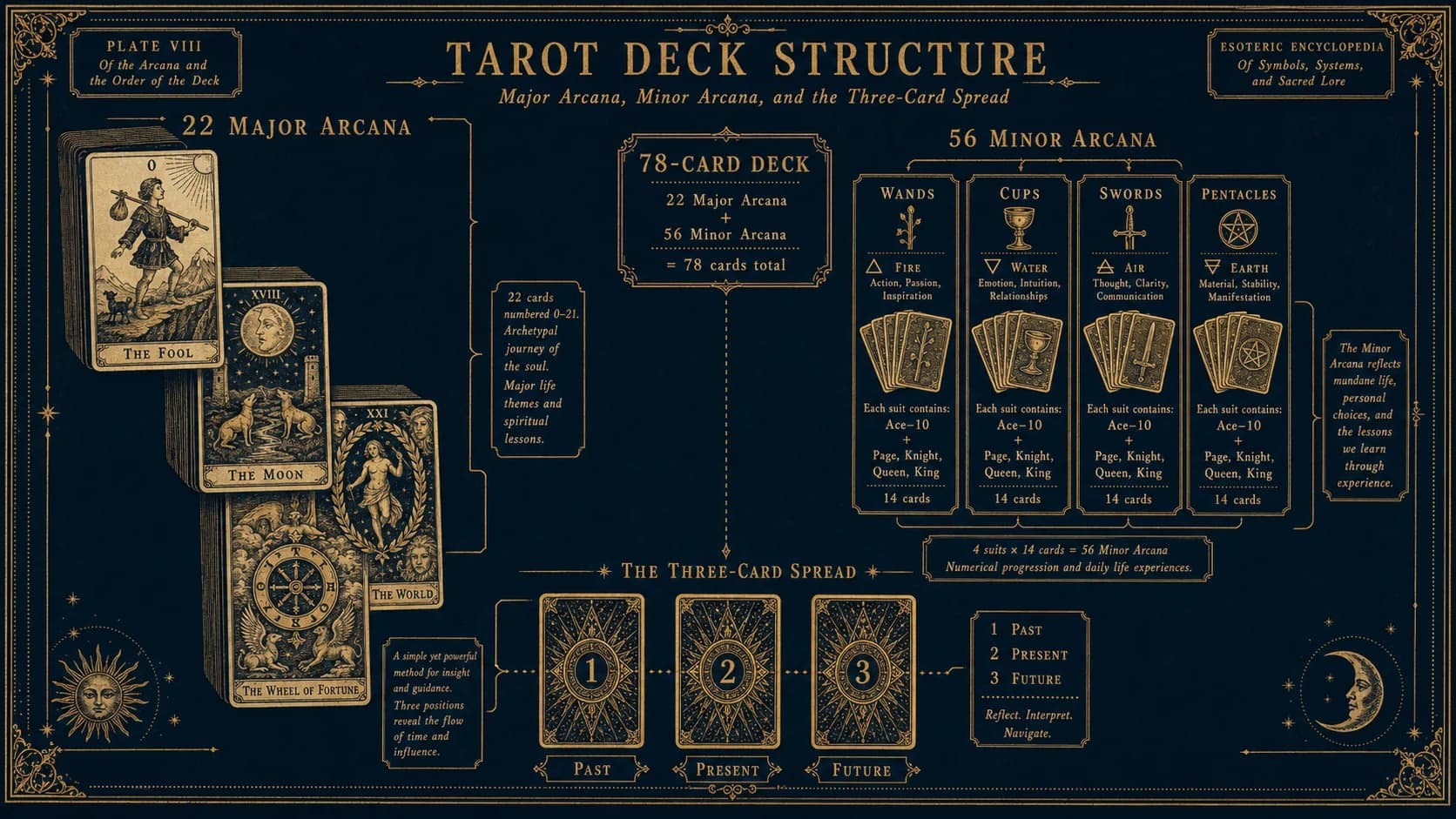
A complete tarot deck has 78 cards divided into two main families. The 22 Major Arcana, from the Fool (0) to the World (XXI), represent the great forces and life themes: love with the Lovers, change with the Wheel of Fortune, transformation with Death. These are the most symbolically charged cards. The 56 Minor Arcana deal with daily life: they are divided into four suits: Wands (fire, action, ambition), Cups (water, emotions, relationships), Swords (air, thought, conflict) and Pentacles (earth, matter, money). Each suit runs from Ace to 10, then has four court cards: Page, Knight, Queen, King.
The 3-card spread is the best entry point for a beginner. Take the deck in your hands, think of a situation that concerns you, shuffle slowly. Draw three cards face down, then turn them one by one. The first evokes what belongs to the past or the causes of the situation. The second speaks of the present, of the energy at play right now. The third opens onto a possible future, a direction to explore. Observe the images before consulting the meanings: your instinctive reaction is always significant.
Do you need psychic gifts to read tarot?
Not at all. Tarot works as a symbolic system: you learn the meaning of the cards, then interpret them in context. Intuition develops with practice, but it is not a prerequisite. The best readers are first good observers, attentive to nuance and the connections between cards.
Which tarot deck should I choose to start?
The Rider-Waite-Smith (1909) is universally recommended for beginners. Its figurative illustrations on every card (including the Minor Arcana) make intuitive interpretation enormously easier. Most reference books and guides are based on this deck. Once you master it, you can explore other more artistic decks.
Does a reversed card change everything?
Reversed cards (drawn upside down) are an optional layer of interpretation. When taken into account, they generally indicate blocked, internalized or integrating energy, not necessarily something negative. As a beginner, you can completely ignore reversals at first and focus on upright meanings.
Take the next step
Cards don't predict, they reveal
Draw My Cards